An ongoing illustrative history study
This piece originally posted 2/5/2021
Prelude | 65 | MLK | CMB | 66 | 67 | 68 | 69 | 70 | 71 | Email |
|---|
"Movements are not radical. Movements are the American way. A small group of abolitionists writing and speaking eventually led to the end of slavery. A few stirred-up women brought about womens' voting."
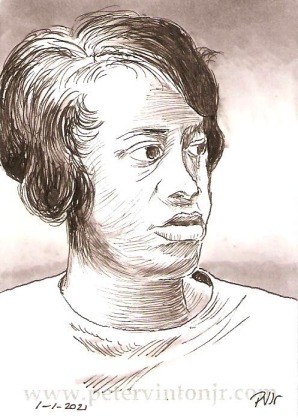
Unita Zelma Blackwell was born to sharecropper parents in 1933 Mississippi. Her education ended at the eighth grade because of a lack of options for African Americans in Mississippi at that time; she joined her parents in chopping cotton for $3 a day. In 1964 the Student Non-Violent Coordinating Committee (SNCC) visited her hometown, and Blackwell signed up; persuading her black neighbors --and eventually black voters across the state-- to register to vote.
That same year Blackwell was named as a delegate to the Mississippi Freedom Democratic Party (MFDP), which pushed to be seated at the Democratic National Convention in New Jersey. Though ultimately denied participation, the MFDP gained notice and stature, and would be instrumental in passing the Voting Rights Act of 1965. As for Blackwell herself, she ultimately was elected mayor of her hometown (Mayersville, Mississippi) --the first black woman to serve as mayor in the entire state. Her tenure (1976 - 2001) was marked by fierce determination to improve the quality of life for Black residents.
Blackwell made 16 diplomatic trips to China throughout the 1970s, and was the president of the US-China Peoples Friendship Association. She was named to President Jimmy Carter's Energy Summit at Camp David in 1979. In 1989 she was elected Chair of the National Conference of Black Mayors. She made a run for Congress in 1993 but was defeated in the primary by Bennie Gordon Thompson (Miss., 2nd dist.), who holds that office to this day. Blackwell died in 2019 at the age of 86.
Your reading assignment: The Unita Blackwell autobiography: "Barefootin': Life Lessons from the Road to Freedom" (published 2006)
Next page - Lesson 68: Asa Philip Randolph