An ongoing illustrative history study
This piece originally posted on 07/04/2026
Prelude | 221 | 222 | 223 | 224 | 225 | 226 | 227 | 228 | 229 | Email |
|---|
As we meditate upon and consider the now 250-year-old words of Thomas Jefferson this weekend, consider also the "classically American" meals that many of us will be enjoying --besides the inevitable hot dogs, hamburgers, and buffalo wings, there will also undoubtedly be three additional items on the cookout menu: french fries, macaroni and cheese, and vanilla ice cream. Which neatly brings us back to Thomas Jefferson --or more accurately, another member of the household at Monticello.
Meet James Hemings, the very first French-trained American chef. Born enslaved in 1765, Hemings was the son of wealthy planter John Wayles and his concubine slave Elizabeth "Betty" Hemings --the second of six siblings. Wayles also had an older daughter, Martha Wayles, who would later become Mrs. Martha Jefferson --making James Hemings the half-brother of Martha Jefferson. (The youngest of James's siblings, Sally, certainly merits an entire study of her own, but we'll circle back around to her story.) After Thomas married Martha in 1772, ownership of James and his siblings passed to the Jeffersons by partus sequitur ventrum. Being three-quarters European by ancestry and being unusually light-complexioned, the Hemingses enjoyed more privileges and exceptions than the darker-skinned field hands. Jefferson saw to it that the Hemings were literate, and spoke of James in particular as being especially bright and eager to learn.
In the aftermath of the Revolution, in 1784, Jefferson was named by the brand-new nation as America's Commerce Minister to France. He brought James (now 19 years old) with him, and for the next five years James studied under some of the greatest chefs in all of Paris. During this time Jefferson paid Hemings an actual wage, also ensuring that James learned French. In that time Hemings was apprenticed to different pastry chefs and other masters of the trade, including one chef of a prince. He eventually earned the title of chef de cuisine in Jefferson's kitchen, preparing and serving dishes to many diplomats and other guests. Among the many dishes he mastered were "macaroni pie;" forerunner to what would become macaroni and cheese, as well as "snow eggs," which led into what would one day be known as vanilla ice cream.
In 1789 France abolished slavery and Jefferson expressed worry that James might at some point demand his own freedom, but Hemings surprised everyone by pursuing no legal action and returning to Monticello with Jefferson when his time as Commerce Minister was up --bringing with him all his accumulated culinary knowledge. Jefferson continued to pay James, employing him during the brief time the United States government operated out of New York. Hemings was the chef for the critical June 20, 1790 dinner (i.e., "the room where it happened") where Jefferson famously mended fences with Alexander Hamilton and agreed to establish the District of Columbia as the permanent capital of the new nation. After the Constitution took effect, James also accompanied Jefferson to Philadelphia while that city served as the capital. However Pennsylvania had by this time also abolished slavery and instituted a policy of freeing any slave in the state for more than six months. The Washingtons had already figured out an end-run around this policy (see Lesson #123 about Oney Judge for more about how well that worked out for them), and Jefferson, faced with a similar situation with James Hemings, eventually worked out a contract agreement with the young man in which he would be freed after training up a replacement chef at Monticello. Hemings agreed and passed on all of his accumulated knowledge to his younger brother Peter, who was also literate in both English and French. In 1793 James set out from Monticello as a free man, ready to embark on his own career as a master chef.
Unfortunately despite his master-level credentials James's life didn't exactly open up with endless possibilities; he journeyed back to Europe for a time and then returned to Philadelphia where he worked as a cook, and then eventually to Baltimore where he worked in a tavern. Several times James returned to Monticello but never lingered for more than a few months at a time. He never married nor had children, and pointedly refused Jefferson's offer of working as the White House head chef when he became President in 1801. He returned to Baltimore but inexplicably died by suicide in November of 1801 at the age of 36.
As you enjoy your french fries, vanilla ice cream, and especially your macaroni and cheese this summer, take a moment to thank the young man who ensured that these dishes found their way to America.
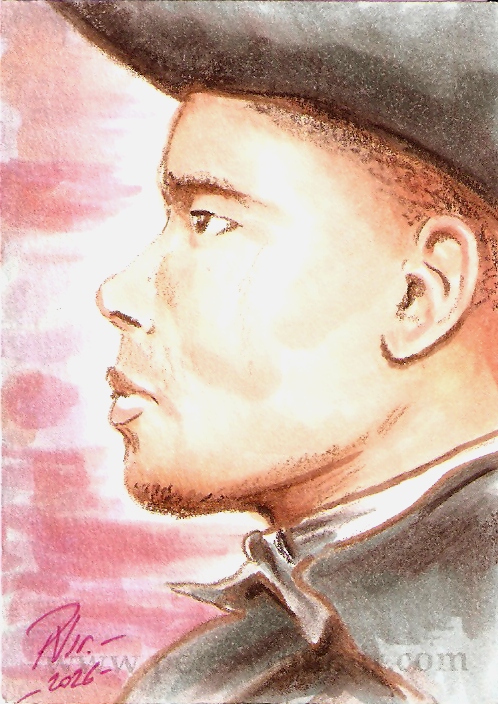
(Once again as an artist I was frustrated by the absence of any actual images of James Hemings that I might reference --one popular internet search result is an unattributed painting frequently said to be of Hemings and also of George Washington's enslaved chef Hercules Posey but is in fact neither man. I ended up inventing this likeness, imagining Hemings with the described light-skinned Senegalese features of his mother Betty and also depicting him as a very young man --looking out on uncertain horizons and wondering just where this new life in France is going to lead him. To that subject I just have to gush about the outstanding work by my fellow artist Ronald Jackson and the creative --yet respectful-- way in which he depicts Hemings.)
Founding Foodie: an in-depth examination of James Hemings's life that aired on NPR in October 2015
Next lesson - Lesson 226: Mary Ellen Pleasant