An ongoing illustrative history study
This piece originally posted on 09/15/2026
Prelude | 227 | 228 | 229 | 230 | 231 | 232 | 233 | 234 | 235 >> | Email |
|---|
"If I had not been there working, I knew I would have been off somewhere crying like everybody else."
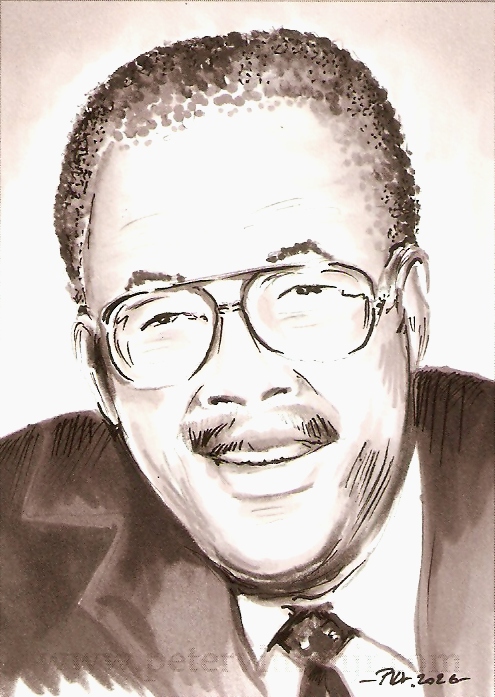
One of the most rewarding aspects of this ongoing project is that the exhaustive study of one life, inevitably leads to a jotting-down of two or three more associated names, more lives to learn about "later." One such name has come up constantly: the accumulated work of photojournalist Moneta Sleet, Jr. Born in 1926 Owensboro Kentucky, Sleet was fascinated with camera technology and a self-professed shutterbug almost from the get-go; his conspicuous absence from most of his family's photographs over the years is explained by the fact that he was inevitably the photographer. The same may be said of his professional career --there are relatively few pictures of the man. Graduating from Kentucky State University with a business degree, Sleet's career veered off into an all-Black Army unit during WWII. However after the war his passion for photography proved undimmed, leading him to New York University, where he ultimately attained his Master's in journalism, in 1950.
His professional career went forward swiftly: he began as a sportswriter for Amsterdam News in New York but in very short order was regularly working for publications such as Ebony and Jet. Sleet's photos of popular figures such as Dizzy Gillespie and Billie Holiday (including one particularly famous shot of Holiday in conversation with author William Faulkner) brought him acclaim and recurring assignments; however his body of work was more than just celebrities and athletes and entertainers; his art covered the much broader Black lived experience. He traveled the world on assignments; covering events in Ghana, Liberia, South America, and (significantly) the Soviet Union. Sleet was also on hand to document so much of the civil rights movement: he was there for the Montgomery bus boycott, was there for the march in Selma; was there for Martin Luther King's acceptance of the Nobel Peace Prize.
Sleet --and those with whom he worked-- understood that if the white press were left to cover everything, that they would control the narrative... and would dictate what stories got left out. Coretta Scott King understood this deep in her soul... which is why she insisted that Sleet was brought into the press pool inside of Ebenezer Baptist Church in Atlanta, for her husband's funeral. A year later Sleet would be the first-ever Black man to receive a Pulitzer Prize (in this instance, for journalism).
In his later years Sleet received honors and awards from the National Urban League and the National Association of Black Journalists (covered extensively in many previous lessons in this series). A comprehensive showing of his work was featured at the Metropolitan Museum of Art in New York City. Today much of his work is now part of the permanent collection at the Owensboro Museum of Fine Art.
Peruse a sampling of some of Sleet's work (including his Pulitzer-winning shot of Coretta Scott King and her daughter Bernice on April 9, 1968), at: https://www.bbc.com/news/stories-50186270. Or see if you can locate a copy of Special Moments in African American History: The Photographs of Moneta Sleet Jr.
Next lesson - Lesson 233: Charlotta Spears Bass