An ongoing illustrative history study
This piece originally posted on 09/24/2026
Prelude | 227 | 228 | 229 | 230 | 231 | 232 | 233 | 234 | 235 >> | Email |
|---|
"Win or lose, we win by raising the issues."
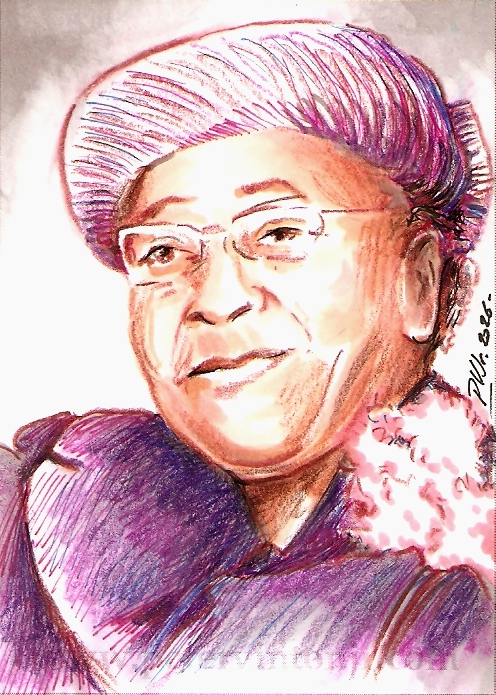
Wow, the profession of journalism really does continue to anger certain people, as of late. Accordingly let us therefore keep discussing that very subject, today with a look at the career trajectory of Charlotta Spears Bass --and all its alarming parallels to the goings-on of today. (Yeah, I know, imagine: a Black woman journalist who enraged people. Wait until you learn what office she ran for...)
Born in 1879 or 1880, in either South Carolina or Rhode Island (the record is unclear and she herself insists it is unimportant), Charlotta Spears begins her story in Los Angeles, to where she moved in 1910. With a semester at Pembroke College already under her belt and years of job familiarity with the world of newspapers, she took a sales job with the still-new Eagle, a Black newspaper founded and managed by John Neimore in 1879. When Neimore died in 1912, Charlotta bought the newspaper and renamed it The California Eagle.
The Eagle illuminated Black life in a way that was not illuminated in other papers; advocating the creation of Black jobs in hospitals, railroads, and telephone companies; also addressing widespread police brutality, restrictive housing... and in particular attacking the Ku Klux Klan. Carlotta criticized that organization and was unabashed in her editorial criticism of the motion picture Birth of a Nation; calling it out for the racist propaganda that it was. In fact, one night several KKK members showed up at her office to intimidate Carlotta while she was alone; she pulled out the pistol she kept in her drawer, and --predictably-- they bolted. Also predictably, the editorial slant of the Eagle ran afoul of the FBI, who viewed it as a "national security threat," and they opened a file on Carlotta, to which they would add for the next forty years. By the end of the 1930's, the Eagle would boast a circulation of nearly 60,000.
After the death of her husband, publisher Joseph Bass, in 1934, Carlotta continued to operate the paper until 1951, advocating for civil rights and also fair wages and labor practices, visibly aligning with outspoken public figures like Paul Robeson (see Lesson #18 in this series). During those years she was an active member of both the NAACP and the Urban League, and also founded the National Sojourner for Truth and Justice Club. After selling the Eagle (to a rival publisher, no less!), she pivoted to politics. Disdaining both of the major parties as being insufficiently aggressive in pursuing social justice, she instead founded the Progressive Party of California, becoming the running mate of prominent San Francisco attorney Vincent Hallinan in the Presidential election of 1952. While the Hallinan/Bass ticket only garnered 0.2% of the vote, it was still the first time a Black woman's name had appeared on a ballot next to the words "Vice-President."
In 1960, Charlotta Bass published her memoir Forty Years: Memoirs from The Pages of A Newspaper. She died of heart complications in 1969. In 2022 the USC Annenberg School for Communication and Journalism launched the Charlotta Bass Journalism and Justice Lab.
Next lesson - Lesson 234: Hazel B. Garland