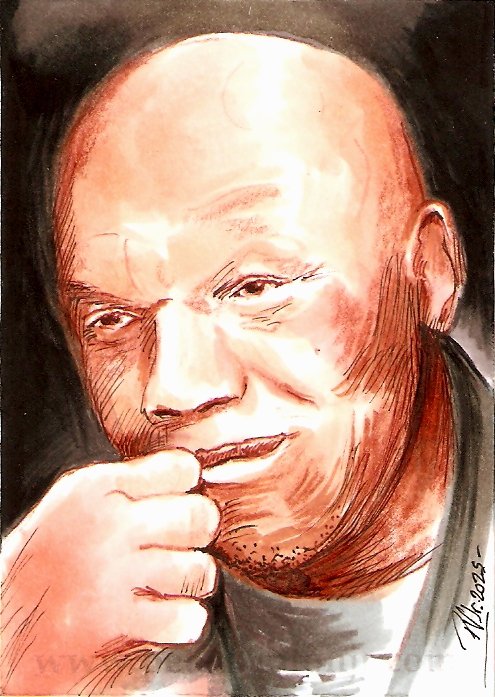
 "That day --April 4, 1968-- was my lesson on what really happens: You are there, yet you don't see everything. But in the tangle of events, there is a sliver of whatever it is that happened that comes past you, and that's precious. All these years later, I still carry that piece, that sliver of what came past me, that which I witnessed at the Lorraine Motel but could not understand in the moment. A lot of times, you do not understand the significance of what you see. But when something truly important happens, those pictures do not fade."
As journalism (or rather, specific practitioners of such) appear to be dominating the headlines as of late, I thought it appropriate to celebrate the achievements of Earl Caldwell, the first Black reporter to become a national correspondent for The New York Times, and the only reporter to be with Martin Luther King Jr. when he was assassinated. Born in 1939 in Clearfield, Pennsylvania, Caldwell graduated from the University of Buffalo and promptly went into journalism --first as a sports reporter for the Lancaster Intelligencer-Journal, and then to the Rochester, NY Democrat and Chronicle. Following this came a stint with the New York Times, during which he covered many civil rights actions, including King's assassination and, later that summer, the events surrounding the 1968 Democratic Party convention in Chicago, including some incidental reporting on what would become known as the trial of the Chicago 7.
Caldwell got on J. Edgar Hoover's/Richard Nixon's FBI's radar in a big way in 1969, when he extensively covered the Black Panther Party and many of its leaders, including founder Fred Hampton and also Eldridge and Kathleen Cleaver (see Lesson #76 in this series). After rebuffing an offer to act as a spy*, Caldwell was subpoenaed and ordered to reveal his sources; to which he of course refused. Consequently United States v. Caldwell eventually fed into the larger Branzburg v. Hayes, a landmark First Amendment case on the limits of reporters' rights to protect their confidential sources. The Supreme Court's disappointing 5-4 ruling was certainly a blow to journalistic standards, but at the same time it prompted many states to then pass "shield laws" that continue to protect reporters today.
From 1979 to 1994, Caldwell became a fixture at the New York Post, covering everything from Jesse Jackson's Presidential runs, to Mayor David Dinkins' time in office, to the fall of South African apartheid. He founded the Reporters Committee for Freedom of the Press, and also served as director of the Robert C. Maynard Institute of Journalism Education. In 1994, he published the seminal Black American Witness: Reports from the Front, which drew criticism for calling out institutionalized discrimination against Haitian immigrants, and ultimately cost him his job at the Post. In 1995, Caldwell won the National Association of Black Journalists' prestigious President's Award (see next lesson for more on the history of that organization). Now retired from journalism but no less busy, he is today the writer-in-residence at the aforementioned Maynard Institute, and is presently working on a serialized account of the role the Black Journalists Movement:
https://web.archive.org/web/20120722061343/http://www.maynardije.org/black_journalists_movement/earl_caldwell/
* - Oh, don't worry, they found other willing participants. Can't have minority communities looking after one another that well, after all...
Consult the Wayback Machine for a comprehensive interview with Caldwell in 2001, about his unique vantage points:
https://archive.org/details/caolaam_000081
And read the transcript of an interview recorded for a 2006 episode of PBS's Frontline:
https://www.pbs.org/wgbh/pages/frontline/newswar/interviews/caldwell.html
 My grateful thanks to the Art Center of Dover, New Hampshire, for very graciously affording me some table space at this year's Holiday Open Studio, at which the above piece premiered, this weekend.
Check them out --these studios are home to some of the most amazingly talented artists with whom I have ever been privileged to share space.
Next lesson - Lesson 208: Les Payne
Return to www.petervintonjr.com Main Page