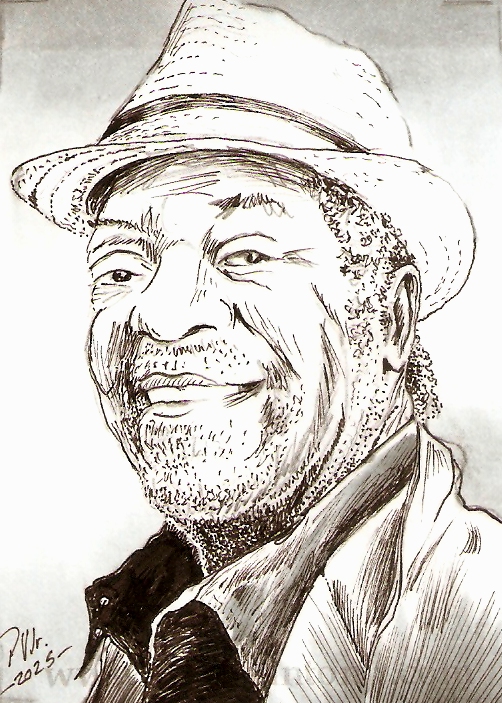
 "Tell the truth, then duck."
An ongoing illustrative history study
This piece originally posted on 12/29/2025
Prelude | 204 | 205 | 206 | 207 | 208 | 209 | 210 | 211 | 212 | Email |
|---|
"Tell the truth, then duck."
In the previous biography I made mention of the National Association of Black Journalists (NABJ); in this entry we celebrate the life of one of its original founders, Les Payne. Born in 1941 Alabama, Payne grew up hyper-aware of the immediate and constant threat posed by the Ku Klux Klan and other forms of looming racial violence. To get away from that intimidation, Payne's parents eventually moved the family to Hartford, Connecticut (not that this constituted any real improvement in race relations, to be sure, but at least the threat of immediate violence was somewhat mitigated.). Payne eventually graduated from the University of Connecticut in 1964 and then joined the U.S. Army, where he not only became a Ranger and attained the rank of Captain, but also became a military journalist (er, excuse me, that's Information Officer); at one point even covering Gen. William Westmoreland at the height of the Vietnam war. Journalism remained his passion after returning to civilian life, and in 1969 (on the recommendation of none other than Bill Moyers), joined the staff of Newsday, where --unusual for most journalism careers-- he would remain for the next 39 years.
He became an assistant managing editor in the 1990s, and then deputy managing editor in 2001. Over the course of his career he covered (much like his colleague Earl Caldwell) the immediate aftermath of Martin Luther King's assassination and a behind-the-scenes look at the Black Panthers Party. He also shone unwelcome light on redlining, school segregation, migrant prison camps, and the Attica Prison rebellion, and conducted some contentious interviews with figures such as New York Mayor Ed Koch and the Rev. Al Sharpton. He also covered the Soweto uprising in South Africa (for which he received a Pulitzer nomination, though not the actual award); controversially Payne observed of apartheid that "South Africa is learning this from the Americans;" that "you don't have to have signs --drinking fountain signs and such-- to segregate people. I think America is the most successful experiment in the world for apartheid. It's done with subtlety but unerring certainty."
Perhaps one of Payne's most pivotal accomplishments was his work on The Heroin Trail (PDF file), a 1974 project that exposed, in 33 installments, a veritable "farm-to-table" tale. It traced international flow of heroin from the poppy fields of Turkey, all the way to New York City's drug addicts, and all the disquieting steps along the way --while this series would ultimately win Payne a Pulitzer, it certainly didn't come without danger; at one point he and two colleagues were captured in Corsica by one of the world's then-most notorious drug lords, Marcel Francisci.
Payne retired from Newsday in 2006. He had been working on an examination of the life of Malcolm X at the time of his death, in March of 2018. The Dead Are Arising: The Life of Malcolm X, was published posthumously in 2020, with assistance from his daughter Tamara Payne.
A more comprehensive list of Payne's published pieces and accomplishments while at Newsday: https://projects.newsday.com/long-island/les-payne-former-newsday-editors-work/
And on that note: I am announcing another temporary rest in this educational series. As of today the project stands at 208 biographies, with more than 208 corresponding pieces of artwork (accounting for a handful of "off-subject" pieces like Quintard Taylor and some entries that merited more than one illustration, like Dred and Harriet Scott). However one measures it, in five years I have now generated the equivalent of four decks of playing cards and I am once again tasked with putting this accumulated body of work to more immediate, useful purpose. While these trading cards have found their way into galleries, activist and social justice organizations, elementary and middle schools, and even some churches; as an artist I must again permit myself a pause in the activity. I make no excuse except to say that every artist really does require these moments from time to time; whether that artist works in words, notes, images, fiber, clay, stanzas, or pixels. Heaven knows 2025 was mightily unkind --even cruel-- to a lot of us, and it's anyone's guess as to what 2026 may yet bring. There is a huge amount of work still to do and I'm not giving up on it (Les Payne certainly never did), but at least in terms of generating new biographies and accompanying art, No. 208 somehow seems a reasonable enough exit to pull off the main road, grab a snack, and recharge. I've some new projects and some new appearances planned for 2026 that --I hope-- are going to be a little bit different from my usual comic book fare.
In the meantime go help someone local. You know there's someone in your town who urgently needs it, or at the very least you know the name of the nearest organization that can help. Go give that organization some of your time or money (or both). That need doesn't end just because the holiday season has wrapped up. (And if you haven't done so already, I really must once again highly recommend taking in the totality of Ken Burns's new The American Revolution series on PBS; truly, so much information --and so many names-- that our traditional narrative has just plain left out.)
See you all soon. Here if you need me.
Next lesson - Lesson 209: Alice Allison Dunnigan
